Autonomous AI Agents & Workflows.
Architect autonomous agents with tool integration and human oversight.
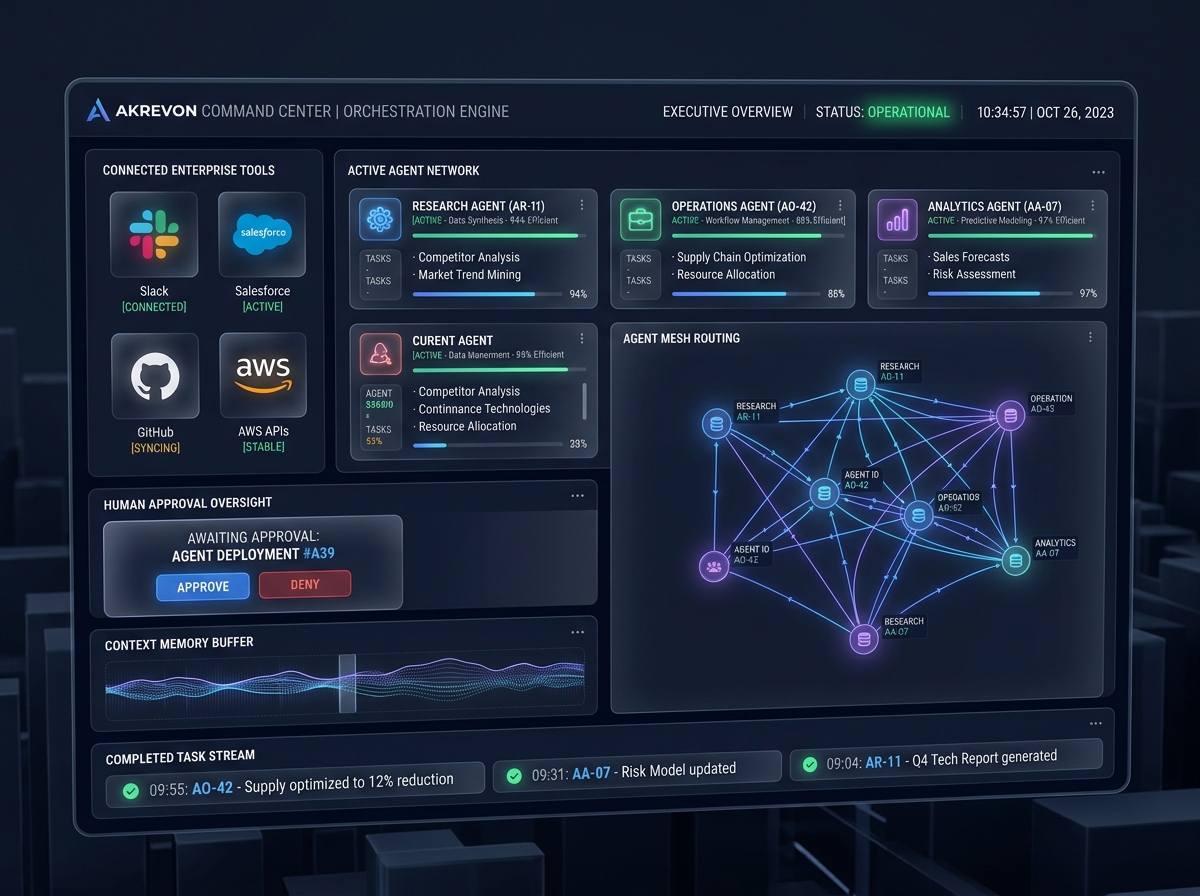
AKREVON designs and builds goal-directed AI agent systems that reason through multi-step tasks, interact with approved enterprise APIs, manage contextual memory, and keep humans in control.
COORDINATED MULTI-AGENT SWARMS · TASK ROUTING · HUMAN OVERSIGHT
PRODUCTION-READY CAPABILITIES
Production-ready ai agents built for real-world use.
Moving beyond passive chat: we build proactive software agents capable of executing multi-stage workflows across complex software ecosystems.

Autonomous Tool Execution
Equip models with secure function calling to query databases, call REST APIs, dispatch emails, and execute commands.

Multi-Step Workflow Orchestration
Stateful graph execution patterns (LangGraph, custom state machines) enabling dynamic branching, retries, and task decomposition.

Hierarchical & Episodic Memory
Hybrid memory architectures combining short-term scratchpads with persistent vector retrieval of past user interactions.

Human-in-the-Loop Safeguards
Explicit approval gates for high-impact actions (financial transactions, data deletions, customer-facing messages).

Trajectory Observability & Tracing
Comprehensive visual trace graphs detailing every intermediate thought, tool call, latency step, and token cost.

Permission Sandboxing & Security
Granular scope limits, ephemeral credentials, rate limiters, and outbound firewalls preventing runaway agent actions.
AGENTIC CONTROL FRAMEWORK
Agent architecture with human oversight.
Enterprise agents must not run unconstrained. AKREVON engineers multi-agent systems with explicit sandbox perimeters, least-privilege tool execution, and deterministic human approval gates.
Autonomous Reasoning
ReAct loops, chain-of-thought planning, and sub-goal decomposition enabling agents to navigate complex multi-step objectives autonomously.
Tools & API Execution
OpenAPI-grounded function calling executing database updates, CRM modifications, ERP entries, and external service calls inside sandbox boundaries.
State & Memory Fabric
Dual-tier memory combining ephemeral working session graphs with persistent vector storage of past user decisions, preferences, and enterprise policies.
Least-Privilege Permissions
Role-based access controls enforcing strict blast-radius containment, credential scoping, and cryptographic verification for all external tool calls.
Human-in-the-Loop Approvals
Deterministic escalation checkpoints halting autonomous execution for financial thresholds, critical data mutations, or high-uncertainty decisions.
Observability & Tracing
Step-by-step OpenTelemetry tracing capturing intermediate thoughts, tool latency, token consumption, and failure modes across the entire agent lifecycle.
STRATEGIC GUIDANCE
Four questions before deploying AI agents.
Essential considerations for agentic autonomy, sandboxed tool access, verification gates, and enterprise safety.

How We Build Autonomous AI Agents
We design multi-agent orchestration frameworks with reliable tool execution, durable state memory, human-in-the-loop checkpoints, and tracing.

Why Build with Multi-Agent Systems
Autonomous agents go beyond passive chat by taking real actions, interacting with APIs, executing database queries, and self-correcting errors.

Why AI Agents for Your Business Operations
Agents handle multi-step operational tasks that previously required human triage—reducing response times from hours to seconds with guaranteed auditability.

Why AKREVON for AI Agents
We engineer robust guardrails, deterministic state machines, and fail-safe human approval gates so autonomous agents operate safely in mission-critical environments.
FREQUENTLY ASKED QUESTIONS
AI Agents, answered.
How do you stop an agent from doing something unexpected?+
We implement strict human-in-the-loop gates for all state-modifying actions, enforce token/step limits, and run all tools in sandboxed environments.
Can agents interact with legacy internal software?+
Yes. We build custom API wrappers, database connectors, and secure web automation adapters allowing agents to interact with on-premise systems.
What frameworks does AKREVON use to build agents?+
We leverage LangGraph, CrewAI, Autogen, and our own lightweight TypeScript/Python state machines tailored to client performance needs.
How do you measure agent accuracy and success?+
We establish end-to-end benchmark suites evaluating task completion rates, intermediate reasoning quality, tool execution precision, and cost per run.
Architect production AI with AKREVON.
Discuss enterprise architecture, vector database selection, token latency budgets, and security parameters with our principal AI engineers.